Community Academy
Learnitas
50 programming languages, 371 terms in computer science, and 206 more across founders, finance, physics, chemistry, electrical engineering, and artificial intelligence, written up and bound into one illustrated archive. Read it like a book, browse it like a library, search it like an index.
New here? Read what this actually is before you dive in.
Programming Languages
50 languages, each given its own page. Use the review deckto track your own progress, or browse the mind map and catalogue below.
OOP / Enterprise
C#, Dart, Delphi, Groovy, Java, Kotlin, Objective-C, Scala, Swift, Visual Basic .NET
Scripting / Dynamic
Bash, JavaScript, Lua, Perl, PHP, PowerShell, Python, R, Ruby, TypeScript
Terms & Knowledge
371 terms in 28 domains, arranged the same way they sit in the vault.
Core CS Fundamentals
Data Structures and Algorithms (18), Operating Systems (11), Computer Networks (10), Computer Architecture (8), Theory of Computation (11), Discrete Mathematics (8)
Software Engineering & Applied Systems
System Design and Distributed Systems (8), Cybersecurity (8), Software Engineering Practices (6), Software Development Methodology (20), Advanced Databases (9), Cloud and Infrastructure (16), Compilers (6), Cloud Platforms (12), Business and SaaS Platforms (21), Data Engineering (10), Legal and Compliance for Tech (9)
Toolchain & Delivery
DevOps Toolchain (11), Testing Tools and Frameworks (8)
Product, Design & Emerging Fields
Blockchain and Web3 (9), Design and UX-UI (9), Product Management (8), Game Development (7), IoT and Embedded Systems (7), Quantum Computing (8)
Specialized Domains
Full-Stack (49), Machine Learning and Deep Learning (27), Git (37)
Beyond Computer Science
206 notes across subjects outside computer science, each its own standalone section rather than a Terms & Knowledge sub-domain.
Artificial Intelligence (27), Founders and Executives (29), Finance and Economics (32), Physics (26), Chemistry (26), Biology (20), Mathematics (20), Electrical and Electronics Engineering (26)
Dare to Know
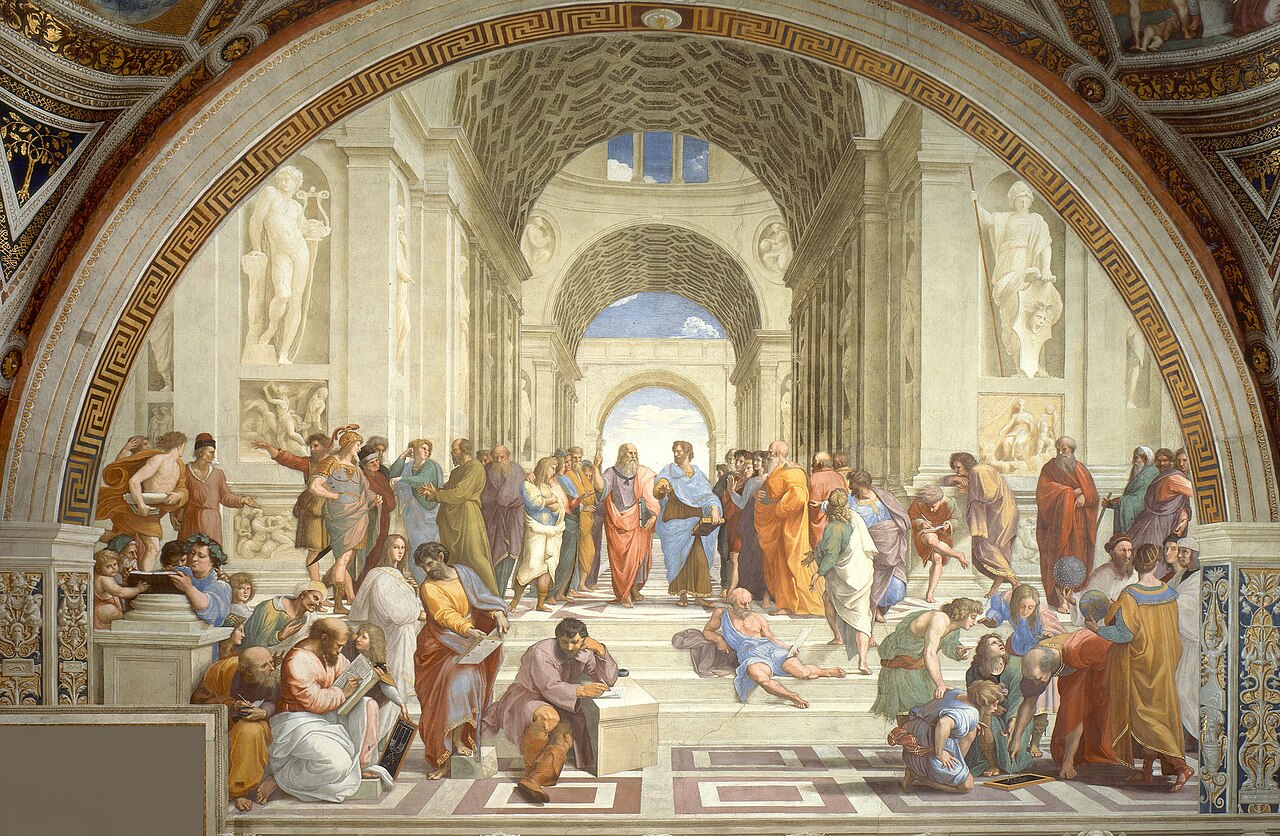
Sapere aude. Horace wrote the line around 20 BC in a letter to a friend named Lollius Maximus, who kept postponing the business of living well. The original sentence is blunter than the motto it turned into: he who has begun is half done, so dare to know, and begin.
Kant revived it seventeen centuries later. In 1784 a Berlin monthly asked its readers a question, and Kant answered with an essay that defined enlightenment as our escape from an immaturity we had imposed on ourselves. The problem was never a shortage of intelligence, he argued, but a shortage of nerve: the habit of letting a book, a priest, or a physician do our thinking for us. Sapere aude was the two word cure.
The room in the painting
Julius II hired Raphael in 1509 to decorate the room where he signed papal documents and shelved his personal library. Raphael was twenty six. He painted the four walls with the four categories those books were sorted into: philosophy, theology, poetry, and law. The School of Athens is the philosophy wall.
Nobody in it agrees. Plato carries the Timaeus and raises a finger toward the world of forms. Aristotle carries the Ethics and holds his palm flat above the ground, where he thought the evidence actually lived. Two hands, and the oldest argument in European thought. Around that pair the disagreement continues at lower volume. Pythagoras writes in a ledger and ignores the room. Euclid bends over a compass in the middle of a proof while students crane to follow it. Diogenes sprawls across the steps, unbothered, in everyone's way. Ptolemy and Zoroaster stand to the right holding a terrestrial globe and a celestial one.
Faces that do not belong to Athens
Raphael populated the fresco with people he knew. Plato has the face of Leonardo da Vinci, then in his late fifties. Bramante, the architect rebuilding St Peter's nearby, lent his face to Euclid. The heavy figure brooding alone on the steps, elbow propped on a block of marble, was added after everything else was finished. Raphael saw the Sistine ceiling while his own plaster was still drying, went back, and painted Michelangelo into the scene as Heraclitus. Raphael put himself at the far right in a dark hat, looking out at the viewer instead of at the philosophers. He is the youngest man in the room and he is not talking.
Why it hangs here
An archive is not a trophy case. A note is worth keeping because it can be corrected, not because it is finished. Every page on this site is a plain markdown file that can be rewritten the moment it turns out to be wrong, which makes the fresco a fair statement of the standard: a room where the best minds available are still arguing, still measuring, still writing things down, and not one of them is done.